News
Cool new looks are in QSR
Carl's Jr. jazzes up a cityscape with its contemporary glass-and-metal prototype.
March 25, 2004
 ChatGPT
 Grok
Grok Perplexity
 Claude
March 26, 2004 It's been almost a year since the first prototype by Santa Barbara's Carl's Jr., who seemed to be the first on the map of revamping the looks of the QSR. But if you have been watching there are several chains that have gone back to the drawing board. The race is on for new development of in-store looks, the concept of how the drive-thru works and even complete overhauls of the concept are definitely the in thing. With the drive-thru continuing the demand attention, McDonalds is working to provide a new look in its drive-thru. In hopes to broaden its appeal to consumers and make the experience one to remember McDonalds has implemented the dual lane drive-thru as well as the single lane with multiple order points. What it very clear is that many of the chains are taking a page from the emerging Fast Casual segments playbook. Make the environment inviting with new colors, smoother lines, plush store fixtures and a focus to reduce the counter lines during peak hours. "This will be a big task for the mainstay QSR's but one they will have to stay on track with, if the expect to be in on the next phase of food concepts", stated Paul Barron of BMG Consulting, a leading group of Restaurant experts in technology and customer interface concepts. New looks will start to establish in the market and even the crossing of lines could occur. It will be hard for the consumer to tell the difference from a Carl's Jr. or a Panera Bread. With QSR clearly having the real estate advantage of their close siblings of fast casual, the shakeout of this segment could simply be the decision of chains like Carl's Jr. and McDonalds just making the commitment to change their look. If you cruise down Firestone Boulevard in Downey, Calif. looking for the new Carl's Jr. restaurant, you won't find it. But if you keep your eyes peeled for a building that looks like, say, an art museum, you will. That's because the burger chain's new prototype looks nothing like a quick-service restaurant. Free from fast food's iconic bright colors, mansard roofs and brick exteriors, and the triangular glass-and-metal building juts out of the cityscape. By day its abundance of glass and steel reflect the Southern California sunshine. At night, the well-lit structure glows, exterior lights casting stars on its metal skin. The interior, laden with industrial finishes, is as contemporary as the exterior. Glass windows are sheathed in metal frames. Exposed ductwork and halogen lamps hoveroverhead. Metal-backed chairs are stamped with the Carl's Jr. star logo. Bright-blue counters, red condiment shakers, a mustard circle poured into the gray concrete floor and mustard booth fabric lend spots of color.
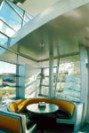
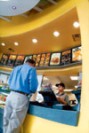 Far Left: Monochromatic booths with a hint of mustard add the detail to complete a modern style dining experience. Middle: Rounded well lit walk-up counters invite customers into a warm and new QSR atmosphere. Far Right: Cylinder booths complete the open, well-lit dining table so customers can enjoy both the interior and exterior.The avant-garde design didn't come about by accident. When they sat down to discuss a new prototype, as they do every five years, executives decided they wanted a building as high-profile as its Famous Star burger, says Andrew Puzder, president and CEO of Santa Barbara, Calif.-based CKE Restaurants Inc. "This time, we wanted to get out ahead of the competition and distinguish ourselves from the competition," Puzder says. "And we wanted to move away from fast food and more into a fast-casual feeling." To achieve that feeling, the company hired Los Angeles-based Rothenberg Sawasy Architects, a firm known for everything but its work in quick-service.
Far Left: Monochromatic booths with a hint of mustard add the detail to complete a modern style dining experience. Middle: Rounded well lit walk-up counters invite customers into a warm and new QSR atmosphere. Far Right: Cylinder booths complete the open, well-lit dining table so customers can enjoy both the interior and exterior.The avant-garde design didn't come about by accident. When they sat down to discuss a new prototype, as they do every five years, executives decided they wanted a building as high-profile as its Famous Star burger, says Andrew Puzder, president and CEO of Santa Barbara, Calif.-based CKE Restaurants Inc. "This time, we wanted to get out ahead of the competition and distinguish ourselves from the competition," Puzder says. "And we wanted to move away from fast food and more into a fast-casual feeling." To achieve that feeling, the company hired Los Angeles-based Rothenberg Sawasy Architects, a firm known for everything but its work in quick-service.
Barron Marketing Group consults for the Quick Service, Fast Casual and Casual Dining industries on Restaurant Operations, To-Go and Drive-Thru system's and Sales & Marketing along with all aspects of restaurant needs.
Related Media
Subscribe
Get the latest news and resources from QSR Web.
Recent Posts

Report: Restaurant brands increase tech spending despite margin pressures

Wendy’s named official dunks of NCAA March Madness: Launches national promotion
Whitepaper details how digital signage drives drive-thru success
Little Caesars expands menu with Four-N-One Stix LTO
Cicis Pizza takes No. 1 spot on Pizza Marketplace's 2026 Top 100 Movers & Shakers list