Food & Beverage
National Fast Food Day: Celebrating the visionaries and brands that shaped an industry
November 16, 2026 by Valerie Gritton — Editor, Pizza Marketplace
 ChatGPT
 Grok
 Perplexity
 Claude
Every year on Nov. 16, National Fast Food Day gives consumers a reason to celebrate one of America's most recognizable dining traditions. Whether it's a favorite burger, a bucket of fried chicken, a slice of pizza, a frozen treat or a late-night drive-thru run, fast food has become more than a convenient meal. It's woven into the fabric of American culture.
But behind the familiar menus, iconic brands and memorable food moments is an industry built by entrepreneurs who recognized an opportunity to change the way people eat. From roadside hamburger stands and drive-ins to global restaurant chains and digital-first dining experiences, fast food has continually reinvented itself to keep pace with changing consumer expectations.
And its evolution is a story worth celebrating.
The pioneers who built an industry
Long before mobile ordering, delivery apps and loyalty programs, a handful of entrepreneurs were laying the groundwork for what would become the modern quick-service restaurant industry.
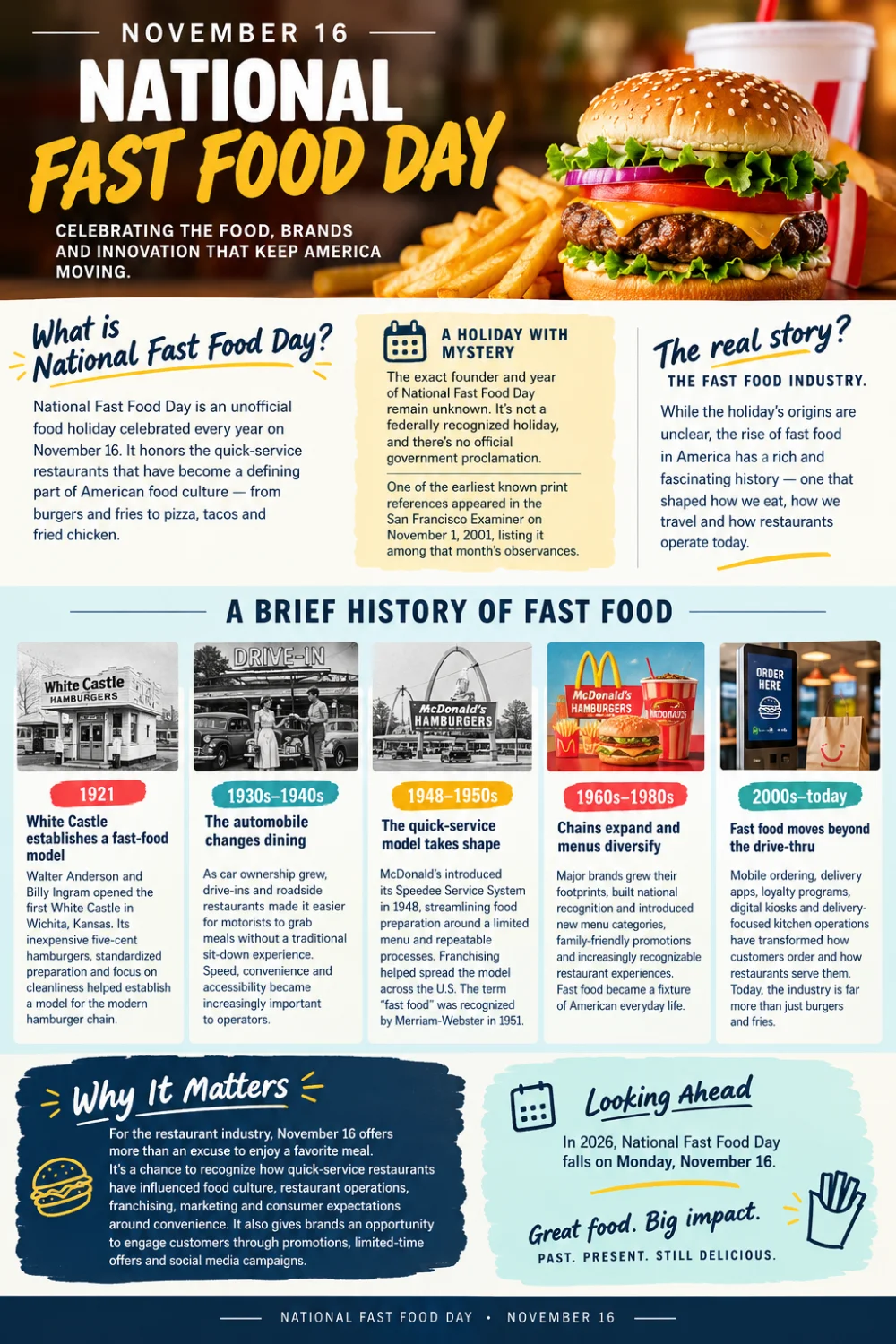
In 1921, Walter Anderson and Billy Ingram opened the first White Castle in Wichita, Kansas, and their approach to producing consistent, affordable hamburgers helped establish the foundations of the modern fast-food restaurant. White Castle emphasized standardized preparation, recognizable branding and an efficient operating model, introducing consumers to the idea that a quick hamburger could become an everyday dining option. The brand also popularized the term "slider" for its small, square hamburgers — a term that now appears on restaurant menus across the industry.
A few years earlier, in 1919, Roy Allen had opened a root beer stand in California. His partnership with Frank Wright helped establish A&W, a brand that would become synonymous with roadside dining and the emerging drive-in culture. Its signature root beer — and especially its classic root beer floats — became part of the experience, turning a simple beverage into an iconic American treat.
And as automobiles changed how Americans traveled and socialized, restaurants found new opportunities to bring food and beverages directly to consumers, and in ways that were fun, interactive and engaging.
The category continued to expand beyond hamburgers and hot dogs, too. In 1940, the first Dairy Queen opened in Joliet, Illinois, introducing consumers to a soft-serve concept that would help make frozen treats a quick-service staple. And serves as another example of how the industry created new occasions for consumers to enjoy restaurant food.
Visionaries who took fast food mainstream
The postwar years brought another wave of innovation, franchising and brand building that would help transform fast food into a national phenomenon.
Few names are more closely associated with that transformation than Ray Kroc. After visiting the McDonald brothers' restaurant in San Bernardino, California, in 1954, Kroc recognized the potential of their streamlined approach to food preparation and service. He became their franchising agent and opened his first McDonald's restaurant in Des Plaines, Illinois, in 1955. His vision for consistency, efficiency and large-scale franchising helped turn McDonald's into a global powerhouse.
Then there's Colonel Harland Sanders, whose determination to share his Southern-style fried chicken helped establish Kentucky Fried Chicken as one of the world's most recognizable restaurant brands. After developing his signature recipe of 11 herbs and spices, Sanders began franchising the concept in 1952, taking his chicken far beyond the Kentucky roadside restaurant where it all began.
And Dave Thomas, who opened the first Wendy's in Columbus, Ohio, in 1969, brought his own vision to the quick-service landscape. With an emphasis on fresh beef, square hamburgers and quality ingredients, Thomas created a brand that stood apart. His entrepreneurial spirit and commitment to the customer experience helped build Wendy's into one of America's leading burger chains.
But Thomas's impact extended well beyond the menu. As an adoptee himself, he became a passionate advocate for children in foster care, making adoption a signature cause of Wendy's and establishing the Dave Thomas Foundation for Adoption in 1992. His commitment went beyond corporate philanthropy, creating a lasting connection between his personal story, the Wendy's brand and a mission to help children find permanent, loving families.
Expanding the definition of fast food
As the industry matured, entrepreneurs continued to challenge what quick-service dining could look like.
In 1958, brothers Dan and Frank Carney opened the first Pizza Hut in Wichita, Kansas, helping bring pizza into the growing quick-service restaurant landscape. Two years later, Tom and James Monaghan acquired a small Michigan pizza shop that would eventually become Domino's. Both brands helped establish pizza as a major part of the fast-food business, with carryout and delivery becoming important components of the category.
Meanwhile, Glen Bell opened the first Taco Bell in Downey, California, in 1962. His concept helped introduce generations of Americans to Mexican-inspired quick-service food, broadening the category beyond its traditional hamburger-and-fries foundation.
These brands didn't simply add new menu items. They expanded dining occasions, introduced new business models and demonstrated that fast food could serve a much wider range of tastes and consumer preferences.
An industry that never stopped evolving
The modern fast-food experience looks considerably different from the one these early pioneers imagined. Yet many of the principles they established — convenience, consistency, affordability and accessibility — remain central to the business. And while the foundation of their products remain the same, what's changed is how brands deliver on their promises.
Today, that means embracing technology, rethinking operations and finding new ways to connect with consumers. Sometimes, it even means picking up the phone. In February, Burger King President Tom Curtis made headlines by sharing his phone number with customers, inviting them to call or text with feedback about everything from the food to the restaurant experience. It was an unconventional approach to customer engagement, but one that underscored an important point: Even in an increasingly digital world, listening to the customer remains fundamental to building a successful restaurant brand.
And with digital ordering, loyalty programs, delivery platforms, mobile apps, drive-thru innovations and increasingly sophisticated restaurant technology, the industry continues to transform how consumers discover, order and enjoy their meals.
National Fast Food Day is certainly a reason to revisit the classics, but it's also an opportunity to recognize the entrepreneurs, franchisees, operators and innovators who helped build an industry that continues to influence how America eats.
From White Castle's early hamburger stands and A&W's roadside roots to Ray Kroc's vision for McDonald's, Colonel Sanders' fried chicken legacy and Dave Thomas' commitment to quality, each generation has contributed something to the industry's evolution.
Their stories share a common thread: recognizing what consumers want and finding new ways to deliver it.
Today's brands are building on that legacy, navigating a more competitive restaurant landscape and responding to consumers whose expectations continue to evolve. The methods may have changed, but the ambition remains the same. So, whether you're celebrating with a classic cheeseburger, a side of fries, a bucket of chicken, a slice of pizza or a favorite frozen treat, take a moment to appreciate the industry behind the meal.
Fast food isn't just about eating quickly. It's about more than a century of entrepreneurship, innovation, memorable brands and the ability to bring people together over something as simple food.
Subscribe
Get the latest news and resources from QSR Web.
Recent Posts

Recent Podcasts