Operations
Rethinking the drive-thru experience for today’s conscious consumer
To combat modern drive-thru challenges like slow service and order inaccuracies, quick-service restaurants are adopting incremental tech upgrades — such as digitized menu boards, upgraded headsets and line-busting tablets — alongside outsourced managed services to streamline operations without overwhelming their staff or budgets.
July 2, 2026 by Michelle Connolly — Director of Sales, Managed Services & Solutions Group, Panasonic Connect North America
 ChatGPT
 Grok
Grok Perplexity
 Claude
Quick service restaurants rely on fast, consistent, and convenient customer experiences that keep people coming back time and time again. For many brands, the drive-thru is an important part of this equation.
Drive-thrus were created to streamline the fast-food process and provide an alternative to ordering and picking up in store, or dining in. But, in 2026, its being reported that too many drive-thru experiences at fast food restaurants are set back by slow service, confusion and frequent order errors.
With increasing competition across the industry, rising food costs and labor shortages, and a demand for efficiency amid wavering consumer confidence, the big question for QSRs is how to fulfill drive thus and boost traffic without sacrificing speed and accuracy that results in poor experiences.
And in a way that makes fiscal and operational sense.
The concept of line-busting takes on new forms
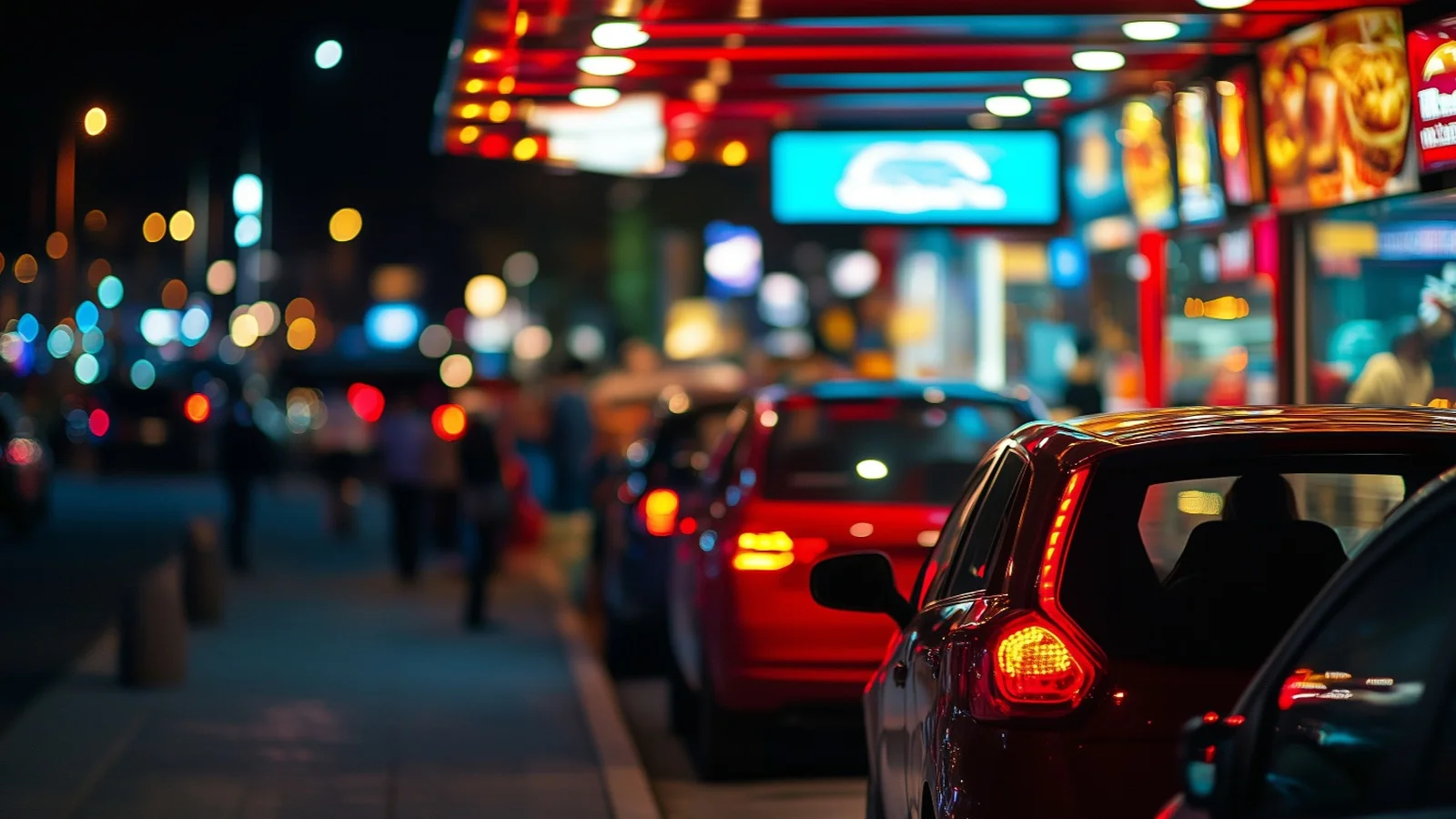
The ideal drive-thru lane is quick and easy for customers, providing an accessible, low-effort ordering experience from the comfort of their cars. What puts this experience in jeopardy is long lines, extended wait times, and inaccurate order fulfillment.
To mitigate these challenges, QSRs are adopting different line-busting strategies. The exact approach looks different for each drive-thru based on size, location, and digital maturity, but the goals are similar. Some are adding a second (or even third) ordering lane to help cut down on wait times. Others have customers wait for larger orders in reserved parking bays to help move things along and create lower perceived wait times for smaller orders. Others are digitizing more of their menu, speaker, and window interface to augment staff and automate certain elements of the experience.
- Digital menu boardsare atop the list of items that promote line-busting in the drive-thru. They keepitem options up to date and promote current deals, while also providing transparency about pricing, and even dietary needs such as gluten-free or nut-free. It eliminates questions at the window and lets staff focus on providing a delightful experience.
- HD headsets are core solutions for drive-thru employees. But as lines get longer and extend further from the window, the systems' connectivity range gets tested. Other factors such as loud noises from vehicles and competing audio conversations can also interfere. Improving headset quality, including those with noise cancellation capabilities, enhance communication between staff members and customers outside.
- Line-busting tablets and terminalsallow drive-thru staff to meet customers where they are, bringing the personalized ordering experience right to their windows. In an age of mobile and online orders, this technology provides the in-person ordering experience with digital speed. This gives more flexibility for cars to park without being in the line, shortening the appearance of the line for prospective customers that are driving past, and allowing customers to relax while they wait for their orders.
A reevaluation of managed services brings new value to drive-thru tech
Gaining traction across the QSR industry is an evaluation of managed services. This is not just from standalone services providers, but also from technology vendors that have dedicated service offerings for QSRs to help keep operations running smoothly.
For QSRs, this closes the gap between technology deployment and management and lets them lean on domain expertise that makes limited sense to keep on payroll. With the additional support of providers who deliver end-to-end support, incremental tech adoption can not only cut down on costly system overhauls and repairs but also allow staff adequate training experience and resources for more successful integration.
Staffing challenges mean that every hire needs to be laser focused on the business and doubling down on what QSRs are designed to do: deliver delicious experiences for customers quickly and accurately. Working with a trusted managed service partner can remove the operational burden from the QSR along the drive-thru journey, giving businesses peace of mind while also opening the door to better sales and marketing opportunities. For example:
- Content management for outdoor menu boards, advertising, or window displays is a critical function that is being outsourced. Deals, promotions and trending items are all drivers of customer attention and purchasing decisions, so the speed and accuracy of content updates and smart, intelligent signage is a must. When content is wrong, out-of-date, or unreliable, it leads to confused customers and miscommunication.
- Call center support and repair services quickly address system outages or damages,minimizing costly downtime and customer dissatisfaction. For every minute a display is down or an audio system is malfunctioning, that's a loss of revenue and a poor brand experience. In today's highly social world, poor experiences are broadcast, posing issues for the QSR in question. Having call center and repair services at the ready promotes more proactive risk management and customer support, as opposed to a reactive one when time is of the essence.
Remember, drive-thru innovation connects to core technology systems
Integrated technology goes beyond the drive-thru window; it connects to a QSR's indoor operations, extending to the kitchen, front counter, and inventory in real-time. Without the proper core technology backbone to support it, drive-thru innovation and line-busting techniques are not as effective, leading to an overflow of orders and overwhelmed systems and staff.
Incremental technology transformation is a great place to start
A recent study by the National Restaurant Association found that only 1 in 10 restaurant operators consider themselves to be at the forefront of technological innovation compared to their peers, while many are still looking to enhance operations with emerging technology.
But for QSRs looking to optimize the drive-thru experience tech innovation is a must, facilitating communication and improving order accuracy to process orders more efficiently.
Incremental transformation, which enables QSRs to adopt new technology without investing in a complete system overhaul, is gaining traction as a viable solution in high-stakes, low- margin businesses. In these models, QSRs can invest in tech upgrades over time, strategically integrating new technology that addresses key operational concerns.
By adopting technology in this manner, and with the support of managed service partners, QSRs can focus on delivering fast and easy experiences to drive-thru customers.
About Michelle Connolly

Related Media
Subscribe
Get the latest news and resources from QSR Web.
Recent Posts
Recent Podcasts