Press Release
The Invisible Injury: Maybe It’s Time to Fix the Most Dangerous Job in Restaurants - By Bruce Friedman
Restaurant kitchens quietly treat burns as normal. Bruce Friedman breaks down the data behind the fry station's injury rate, its cost to operators, and how Flippy is proving that automation can be safety driven and human first, not a replacement for workers.
September 3, 2026
I have had some version of the same conversation more times than I can count. I tell someone I work in restaurant technology, they ask what we build, and the moment I say, "An AI-powered fry station robot," something shifts.
If they have ever actually worked in a kitchen, even for a summer, they roll up their sleeves. There is almost always a scar. A burn from hot oil or sometimes worse. Nobody has to explain what happened. All of this like it is the most normal thing in the world.
That’s the part of this industry that does not make headlines. Burns do not trend. They happen quietly, get treated with a first aid kit or a walk-in freezer door, and get absorbed as a normal cost of doing business in a commercial kitchen. That should not be normal, and the data backs up what every one of those rolled-up sleeves has already told me. And we wonder why the industry labor turnover rate is so high.
Almost 80% of fast food employees have sustained burns within the past year, according to a survey conducted by Hart Research Associates on behalf of the National Council for Occupational Safety and Health. Restaurant workers are burned at a rate of 10.2 injuries per 10,000 employees, nearly seven times the rate across all private industries, according to Bureau of Labor Statistics data. Hot grease alone accounts for roughly half of all burns in fast food kitchens specifically.
Those are not abstractions. That is a scar someone shows me almost every time this comes up in conversation.
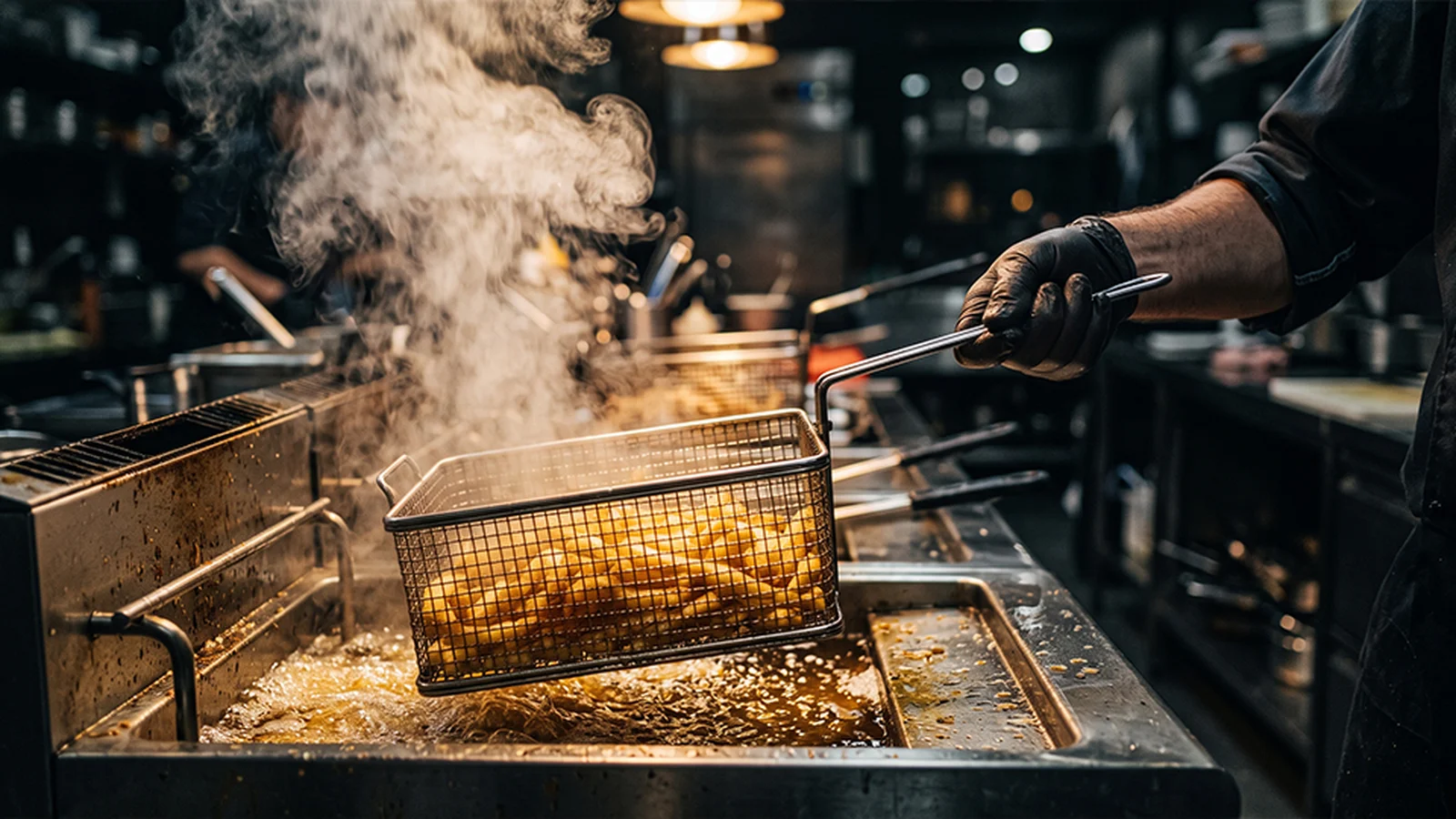
The fry station carries the weight of most of that risk, and it is not a coincidence that it is also the hardest position to keep staffed. Every fry cook who gets burned badly enough to walk away from their job costs an operator roughly $6,109 to replace, per Cornell's Center for Hospitality Research, once recruiting, onboarding, and training are factored in. Workers' comp claims tied to the fryer are one of the largest, and most preventable, cost centers most operators never fully isolate on their P&L.
This is exactly the problem we built our Flippy Fry Station robot to solve, and I do not think we talk about it loudly enough. Locations running Flippy report zero injuries at the fry station, effectively eliminating that entire workers' comp claim category. That is not a minor feature. That is the single most dangerous job in the building…made safe.
This is what we mean when we say the future of restaurants is automated, data-driven, and human-first. The vision and recognition technology behind Flippy is what makes zero injury outcomes possible at commercial scale. It’s data-driven because we can prove it – not just claim it. And it’s human-first because the entire point is protecting the people doing the work, not replacing them. Nobody's job should come with a scar as a rite of passage.
We talk a lot about labor savings when we talk about Flippy, and the numbers are real. But if I am honest, the safety data is the number that should matter most. It is the one that shows up on someone's arm.
By Bruce Friedman, Chief Revenue Officer, Miso Robotics
Included In This Story

Miso
Restaurant AI
Miso Robotics delivers AI automation for restaurants and hospitality. Flippy automates the fry station, reducing labor dependency with consistent execution at twice the throughput of manual operations. Zippy is your employee revenue engine, turning frontline performance into measurable business outcomes in real time.
Related Media
Featured Vendor
Miso Robotics delivers AI automation for restaurants and hospitality. Flippy automates the fry station, reducing labor dependency with consistent execution at twice the throughput of manual operations. Zippy is your employee revenue engine, turning frontline performance into measurable business outcomes in real time.
Subscribe
Get the latest news and resources from QSR Web.
Recent Posts
Recent Podcasts